Data & Analytics
Menu

Work matters. Our earnings ensure the lights stay on, there’s food on the table, and the rainy-day pot is full. With soaring costs and pressure mounting, work-life balance has never been more important, or more difficult to get right.
Recent research from Randstad shows a landmark shift in the workplace. For the first time in over 20 years, work-life balance has surpassed pay as the top motivator for employees. Their data reveals that 83% of workers now prioritise balance, compared to 82% who focus on salary. People are no longer just working to live. They’re choosing roles that protect their time.
The Global Workplace Happiness Report 2026 backs this up. We found that where people work has a larger effect on happiness and engagement than any other variable we studied. Remote and hybrid workers outscore office and field-based workers on nearly every dimension. Specifically, remote workers reported a work-life balance score of 7.6/10, compared to 6.9 for those in the office.
Want to see where your sector sits? Download the Global Workplace Happiness Report 2026 for the full breakdown, or get a custom report benchmarked to your industry and demographics.

We’re more connected than ever. Technology and AI have changed the game. Working from home is no longer new; it’s just how we do things. But this makes it difficult to separate work from personal time. It’s commonplace to check emails at all hours, take business calls at the dinner table and work on our laptops on weekends. How has this become acceptable?
The conversation has moved on from remote or hybrid work. The real differentiator is how we use technology to protect our time. AI is our daily digital colleague that helps us offload repetitive tasks.
But there’s a catch. Employers expect more from their people, which leads to them feeling more pressure to achieve greater results. These pressures appear to have reached a breaking point, as people realise that they need to achieve a better balance in their lives.
If we only use AI to cram in more work, we miss the point. The goal is to reinvest that extra time into human connection, creativity, and rest. Real balance means using tech to work smarter, not harder!
Maintaining a healthy work-life balance isn’t only important for health and relationships, but it can also improve your employees’ productivity and performance. Put simply, if your people don’t view work as a chore, then they will work harder, make fewer mistakes, and are more likely to become advocates for your brand.
Businesses that gain a reputation for encouraging work-life balance have become very attractive – especially when you consider how difficult it can be to attract and retain younger workers these days. The cost of losing your people is rising. According to Centric HR, replacing a mid-level manager in 2026 can cost roughly 20% of their annual salary in recruitment and training. For executive roles, that figure can skyrocket to over 200%. Keeping your current team happy isn’t just a “nice” thing to do. It’s a vital financial strategy.
Here are some more reasons why work-life balance is important for your people and your organisation:
Workplace absence hit record highs in 2025. The CIPD reported that UK employees were off sick for an average of 9.4 days over the year. Mental ill-health remains the top cause of long-term absence. When we are stressed and overworked, we run the risk of jeopardising more than just our social lives. Our physical and mental health is in danger too.
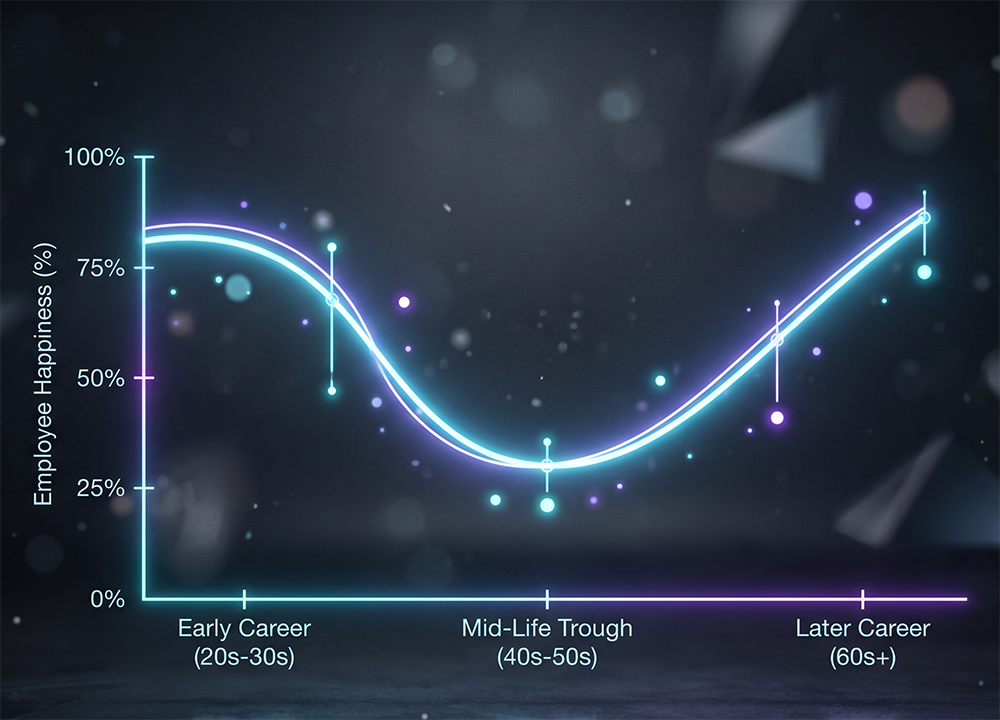
Our 2026 Global Workplace Happiness Report data shows that the early career years (ages 19–29) carry the heaviest burden, reporting the lowest scores for trust and work-life balance. By encouraging your people to look after themselves and find balance early on, you significantly limit health problems and absences. This ensures your organisation is more efficient during business hours. People will actually want to be part of the business and culture.
By helping your people find the perfect balance between work and home, you will increase their engagement levels. This has many positive effects. According to Tower Perrin’s global survey, “Companies with highly engaged employees had a near 52% gap in performance improvement in operating income.” Plus: “Companies with high levels of employee engagement improved 19.2% in operating income, while companies with low levels of employee engagement declined 32.7%.”
Having an engaged workforce will lead to your people going the extra mile for you and becoming loyal advocates for your brand and product.
We all get stressed from time to time. It’s unavoidable. However, workplace burnouts are avoidable, and you should make efforts to ensure this doesn’t happen to your people. Burnouts occur when we feel overwhelmed and unable to meet constant demands. The negative effects of burnout can affect every aspect of our lives.
The inability to separate work from personal life will massively increase the chances of burnout, so it’s important to encourage your team to take time off and truly relax.
When we find and sustain a healthy work-life balance, we develop greater control over our focus and ability to concentrate on the task at hand—this is known as mindfulness. Wouldn’t you prefer a team that is fully focused on whatever they are doing instead of worrying about work/home?
By encouraging your people to have a healthy work-life balance, you will create an environment where everyone is dedicated to the task at hand. This will improve retention rates, productivity and ultimately profit.
Now we know why it’s important, let’s explore how you can ensure your people have a healthy work-life balance:
Holidays are not a luxury. Annual leave is a necessity. A break from work will provide you with the chance to switch off and enjoy yourself. It’s also a great opportunity to recuperate and recharge. This is essential to help your people improve productivity and focus when they return to the office.
An effective way to encourage your people to take time off is to implement a “use it or lose it” system. This ensures any unused days will not be carried over at the end of the year or repaid financially.
Don’t just offer remote work; ask your people what they actually need. Our 2026 research shows that for the cohort aged 19–29, hybrid work outperforms being fully remote in the key areas of career progression and learning. Younger workers benefit from some time in the office for growth, while older workers often value more remote autonomy. Collaborating with your team on these arrangements gives you a better understanding of how they think.
France introduced “Right to Disconnect” laws years ago. Many global organisations have since followed with their own policies. The principle is simple. Respect your people’s time outside work. Don’t contact them when they’re off the clock. People who truly switch off come back sharper, more focused, and more motivated.
Flexibility looks different for everyone. Some people need earlier start times. Others want compressed hours or more autonomy over where they work. The only way to know is to ask. Our engagement platform makes it easy to gather real-time insights from your people, so your flexibility policy is built on data, not assumptions.
Finally, it’s important to lead by example. If you tell your people to shut off their laptops at six and not work over the weekend, but you’re sending them emails during these periods, it sends a very mixed message. It also puts pressure on your people to mirror your working hours.
Interestingly, our research shows that the wider C-suite (excluding CEOs) reports some of the lowest work-life balance scores in our study. Leaders must protect their own balance first to witness how those healthy work practices permeate throughout the business.
If you’re not sure where your culture currently stands, take our free global benchmark and see how you compare worldwide.
By loosening the reins on your people’s work-life balance, you will make huge strides toward building an engaged and productive team.
Download the full Global Workplace Happiness Report 2026 to see the latest work-life balance benchmarks from over 80,000 people across 115 countries.
Many leaders use it to understand trends from similar organisations. The real value, though, comes from applying those insights to your own context. We offer custom, board-level reports with tailored benchmarks for any vertical or demographic, built on our full 1.9 million data points.
Or if you’d rather talk it through, book a consultation with one of our Culture Consultants. They’ll help you turn what you find into a long-term strategy for high performance.
Related articles

Get in touch for a quick chat with one of our experts to see how we can help you.

Take our benchmark to map where your organisation is now, and where it needs to be.